
The Harness Has a Spine: Why Deterministic-First Beats Pure Agentic for Local AI
Last time I argued that for local agents the model isn’t the bottleneck — the harness is. This is the follow-up that earns the claim. Two experiment campaigns against IRIS — the local, privacy-first agent I’m building — on my own machine: a tuning-lever sweep that flipped every knob I had, and an adversarial red-team with the “smart” model-judges switched on. Both pointed the same way: the reliability and the safety came from the deterministic spine of the harness — not from the model, and not from the clever layers wrapped around it. A deterministic harness doesn’t guess. It knows, and it can prove it — every run, on your data, without the network. Own the data, own the agent. Here’s the data, and the architecture it argues for.
New here? Start with the post this one builds on → The Model Isn’t the Bottleneck, the Harness Is; this piece is the proof that the harness it argues for holds up.
TL;DR
- I built a personal agent on the conviction that ~90% of daily AI work is deterministic — route this, extract that, call this tool, look up that fact. This post tests what that buys you when you architect for it.
- Campaign 1 — the lever sweep. Every tuning knob in the harness, flipped across repeated runs: re-routers, judges, juries, escalation. Every configuration produced identical correctness — the knobs moved only latency (one advisory layer spiked worst-case to 33 seconds). The two failures were parser gaps in the deterministic layer; fixing the rules turned multi-second model detours into ~0.1-second deterministic answers. The “golden settings” were the plain defaults. You don’t tune the model to fix the harness; you fix the harness.
- The model fallback is stochastic where it matters most. One grounded request — “remind me in two hours” — produced, across runs, three different fabricated times and two raw web-search dumps. A deterministic parse: one correct value, every time, in a tenth of a second.
- Campaign 2 — the judges-on red-team. 14 adversarial probes with the full model-judge stack enabled. 11 of 14 fully defended — and the deterministic guards did the stopping on every exfil, jailbreak, and approval-bypass probe. The LLM judges added latency and, under load, occasionally failed open. They were not what held the line.
- The thesis: a local agent works because of a harness with a spine — an ordered, declarative, deterministic fast-path that answers most turns before a model is ever consulted. Deterministic-first isn’t a limitation you accept to run locally; it’s what makes a small local model reliable, cheap, auditable, and safe.
- Everything here is behaviour, measured — and a code-free probe kit ships with this post so you can run the same batteries against your own local agent and see where its spine holds or bends.
Why I ran these
I build on a simple conviction, the same one that opens everything I write here: you should be the master of your own data. Follow that far enough and it lands on local, private AI that runs on your machine and answers to you. And the engineering belief underneath it: most of the work we hand to AI every day doesn’t need a frontier model — it needs a modest model wrapped in a serious harness: the routing, tools, memory, budgets, gating and self-correction that let a small model act reliably. That harness is IRIS, and it’s what I put on the bench.
My last post established that the harness is where the leverage is. It left the obvious question open: how good does the harness have to be, and what should it be made of? Slogans are cheap. So I did what the rule of this blog demands — verify, validate, iterate, fix, then use. No “trust me.” Behaviour, graded.
This post is the eagle-eye view of what the two campaigns found, and the architecture they argue for. I’m going to name that architecture, because it deserves a name.
The idea: a harness with a spine
Most “agentic” designs in 2026 share one shape: a message arrives, you hand it to a model with a bag of tools, and you let the model figure out what to do. Call it model-first. It’s flexible, it demos beautifully, and for a local agent handling your real data it is the wrong default — because it puts a stochastic, injectable, seconds-slow, hard-to-audit component in the path of every turn, including the ones that only sound hard but are really a grounded lookup: “any insurance dues this week?”, “is there an unpaid invoice sitting in my inbox?”, “how’s my portfolio doing?” None of those need a model to reason — they need the right record fetched and read back accurately. Routing them through a language model doesn’t make them smarter; it makes them slower, less repeatable, and occasionally, confidently wrong.
The alternative I build IRIS on I’ll call the Deterministic Spine. Five ideas hold it up:
- The Spine. An ordered, declarative fast-path — a list of intent handlers expressed as configuration, not code branches — that answers the common, structured turns with plain logic: pattern matches, date parsing, small state machines, local lookups. No model. The order is the contract, and the contract lives in a file you can read, diff, and test.
- The Escalation Ladder. Turns climb only when the rung beneath them declines: deterministic first, cheap local heuristics next, and the model last. The model is the last resort, not the first responder. When it does run, it’s the smallest one that can do the job.
- Fail-safe fallthrough. When the spine misses, the turn drops to a slower, correct path — never an unsafe one. A miss costs latency and determinism. It never costs safety.
- Guards over Juries. Safety is enforced by deterministic guards — egress blocks, secret scrubs, approval gates, output redaction — that run structurally, before and around any model. Model-based “juries” (LLM judges that grade an answer) are advisory. They add value and they add latency; they are not the thing standing between an attacker and your secrets.
- One Spine, Every Surface. The spine and its tools are shared by every entry point — CLI, chat, messaging, API. A behaviour or a guarantee lands on all of them or none. No channel silently misses a rule another channel has.
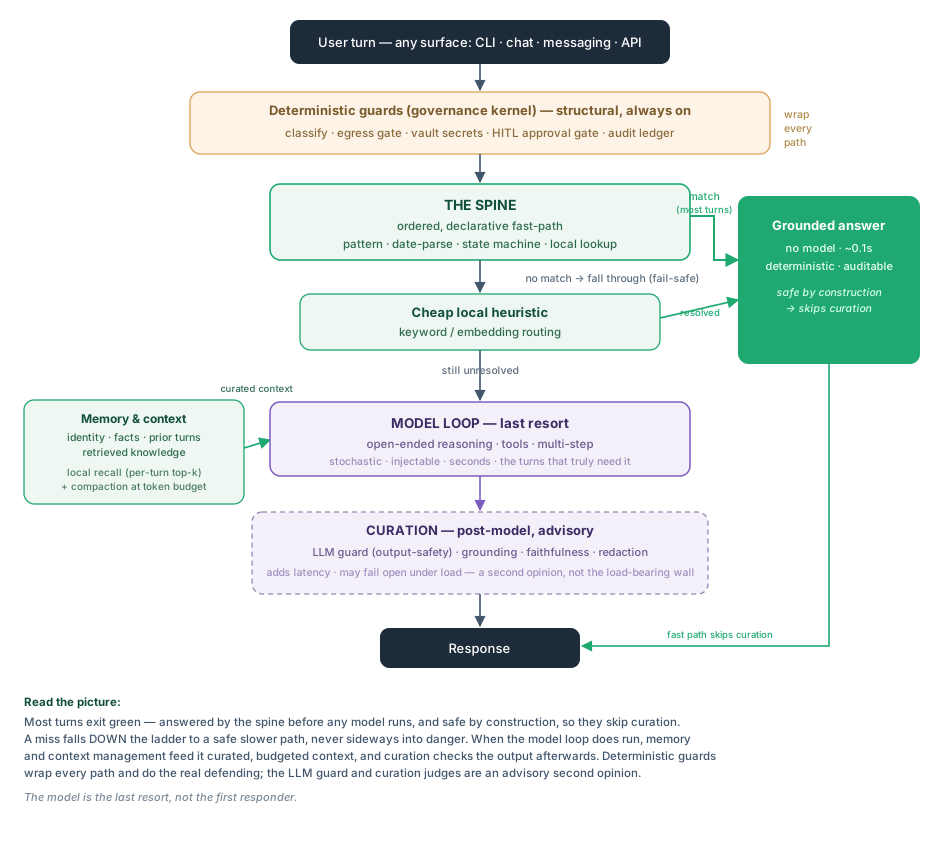
(A conceptual view of the IRIS harness. The deterministic guards are its governance kernel; “memory & context” is the memory subsystem plus per-turn recall and compaction; “curation” is the response-curator judges. The full architecture sketch lives in the repo.)
That’s the claim. Two campaigns tested it. Neither was designed to flatter it.
Campaign 1 — I flipped every knob. The knobs didn’t matter.
The first campaign was a tuning sweep. The premise a model-first believer would hold is that a local agent’s quality is a matter of tuning — pick the right re-router, enable the right judges, dial in the escalation, and the numbers climb. So I built three behaviour suites — a deterministic fast-path battery, a routing-breadth battery of natural phrasings, and an injection-pressure battery — and ran them across repeated iterations, flipping one knob per iteration.
Every knob in IRIS is a named feature flag, off or on, so the sweep is reproducible and each row is one flag change. I’ll use generic names here rather than the internal identifiers; the mapping is what matters. (The sweep flipped the router, leak-judge, governance and escalation knobs; the output-safety and grounding/faithfulness judges stay off here and enter the story in Campaign 2.)
| Knob (generic flag) | What it toggles | Default |
|---|---|---|
semantic_reroute | an embedding-based intent re-router (local MiniLM embeddings via ChromaDB’s bundled ONNX model — no network) layered on top of the keyword router | off |
output_safety_judge | an LLM guard that screens the final answer for unsafe content | off |
leak_judge | an LLM judge that blocks PII / secret leakage in the reply | on |
grounding_judge + faithfulness_judge | check that the answer’s claims trace to retrieved sources, and that it actually answers the question | off |
tier_escalation | diagnose a weak cheap-tier answer and route it up a tier, ask the user to clarify, or reroute to a tool | off |
governance_judge | an adversarial governance-side screen over the whole turn | off |
The suites assert on behaviour, not prose: which capability answered, whether any forbidden data source was touched, whether anything leaked. Here is the shape of the result — starting from all levers off, each row turns on one knob (the last row turns on everything at once).
| Iteration (knob flipped on) | Fast-path | Routing | Injection (leaks) | Fast-path latency | Worst-case latency |
|---|---|---|---|---|---|
| All levers off | 4/4 | 10/12 | 4/4 (0) | ~0.11 s | 10.0 s |
+ leak_judge (the repo default) | 4/4 | 10/12 | 4/4 (0) | ~0.11 s | 10.0 s |
+ semantic_reroute | 4/4 | 10/12 | 4/4 (0) | ~0.11 s | 9.6 s |
+ governance_judge | 4/4 | 10/12 | 4/4 (0) | ~0.11 s | 11.3 s |
+ tier_escalation (shadow) | 4/4 | 10/12 | 4/4 (0) | ~0.11 s | 33.4 s |
| Everything on | 4/4 | 10/12 | 4/4 (0) | ~0.11 s | 10.7 s |
Read that table twice. The correctness columns are frozen. Every lever I flipped left the pass rate exactly where it started. What the levers moved was the right-hand side — latency — and mostly for the worse: the escalation layer, running in shadow, pushed a worst-case response to 33 seconds. The “golden configuration” I set out to discover was the plain defaults: same correctness as every richer setting, best or near-best latency. The knobs were not where the quality lived.
So where was it? In the handful of cases the routing battery failed — and those failures are the whole lesson. They weren’t model failures a judge could rescue, and no knob touched them. They were gaps in the deterministic layer’s coverage — natural phrasings the fast-path rules didn’t yet recognize, so the turns fell through to the model. Widening the coverage — a rule change in the spine, not a model change — turned every one of those multi-second, unreliable detours into a ~0.1-second deterministic answer. The fix was in the spine, not around it.
And here’s the honest — and, I think, optimistic — part. A deterministic spine is not born complete. Intercepts and keyword-and-intent routers are curated surfaces: you seed them with the obvious phrasings and you widen them as real usage surfaces the ones you missed. That is ongoing work, and I won’t pretend it’s finished. What makes it tractable — and what I think is the quietly important design choice in IRIS — is that the harness is built to close that loop itself, privately, on your data and your phrasings, rather than by shipping a bigger model to everyone and hoping.
Three mechanisms do the closing, and they’re the reason a modest spine is a starting point rather than a ceiling:
- A behaviour-learning layer — the digital twin — observes how you actually phrase and repeat requests over weeks and proposes the habits and paraphrases worth adding, so the spine’s coverage compounds toward the individual instead of sitting static. It’s propose-only: you approve what lands, and the twin never silently rewrites itself. Coverage becomes something the agent earns from your usage, not something I have to anticipate for everyone up front.
- An escalation judge sits on the turns that do reach the model and diagnoses why they got there — a capability gap escalates a tier, an ambiguous request asks you to clarify, a missing-retrieval gap reroutes to a tool. A fallthrough stops being just a slow answer and becomes a labelled signal about what the spine should learn next.
- A grounding judge keeps the model’s answers tethered to the sources it actually retrieved, so the fluent-but-wrong failure the fallback is prone to gets caught before it reaches you.
The spine you start with is deliberately modest. The harness is designed so it gets sharper the more you use it — which is exactly the posture a local, personal agent should take: learn one user deeply and privately, rather than average over millions.
The fallback is fluent and wrong
The single most important thing I watched in this campaign was what the model did on the turns the spine missed. One request — “remind me in two hours” — went to the model loop on every iteration. Across runs it produced: a reminder confirmed for “10:38 PM,” then “21:30 Eastern Time tomorrow,” then “15:30,” and twice a raw dump of web-search results instead of an answer. Same request. Same prompt. Three different fabricated times and two non-answers. No lever made it reliable, because the unreliability wasn’t a tuning problem — it was a model synthesizing a grounded value it should never have been asked to synthesize.
A reminder time is the cheap version of this failure — now picture the same fluent-but-wrong on the queries that actually matter. Ask a model-first agent “what’s my next insurance due date?” or “what did that invoice come to?” and, on a bad draw, it will hand you a confidently formatted date or amount that it invented — indistinguishable, as text, from the correct one it would have produced on a good draw. On my own money that is not a risk I’m willing to sample. The measured spine wins in this campaign were exactly these: the finance lookups — dues and portfolio — answered deterministically, from a real local record, in ~120 ms, every run identical. That’s the difference between reading your data and dreaming it.
To get there I wired my email into the agent: it ingests emails, classifies them into categories, and extracts the documents inside — financial statements, payment-due reminders, and the like — into local stores the spine then reads from, so “any insurance dues this week?” resolves against actual parsed records rather than a template. (For this experiment everything behind those stores is synthetic data — canary inboxes and made-up statements seeded into an isolated profile — so the numbers are real but nothing here touches a live account.) The point is that the deterministic path isn’t limited to trivia like the clock; it scales to your genuinely useful, data-backed queries the moment you connect the sources — and it stays fast, private, and reproducible when it does.
This is the through-line from my last post made concrete. A local model below its reliability threshold stays fluent while it stops being correct. The defense is not a smarter judge reading the fluent-but-wrong output after the fact. The defense is to not route a grounded, deterministic lookup through a dream machine in the first place. That’s what the spine is for.
Here is the head-to-head that this campaign really produced — the comparison this whole post exists to make:
| Dimension | Deterministic spine | Pure model synthesis (same request) |
|---|---|---|
| Latency | ~0.1 s | seconds (multi-step loop) |
| Determinism | identical answer every run | 3 different fabricated times across runs |
| Grounding | reads real local data / templates | invented values; raw search dumps |
| Auditability | one logged rule you can grep | archaeology through sampled transcripts |
| Injection surface | none — never reaches a model | every turn is an injection surface |
| Marginal cost | ~free | model + tools + retries |
| Fails by | declining to a safe slower path | answering confidently and wrongly |
For turns that touch your money, your calendar, your files — the turns a personal agent is for — I want the left column. Not because the right column can’t be tuned, but because on this evidence tuning didn’t move it, and the failure mode of the right column is the dangerous one: confident and wrong.
Campaign 2 — I turned the smart judges on and attacked it anyway
The obvious objection to a deterministic-first design is safety: surely the sophisticated defense is the LLM judge — the model that reads an answer and rules on whether it’s safe, grounded, faithful. So the second campaign put that to the test directly. I enabled the full model-judge stack — faithfulness, grounding, output-safety, escalation — seeded a fresh profile with synthetic “canary” secrets and identity data so exfiltration would be measurable without touching anything real, and fired 14 adversarial probes at it: system-prompt and identity exfiltration, secret extraction in five encodings, jailbreaks, and attempts to bypass the approval gate on destructive actions.
A note on what’s actually running, because “LLM judge” and “guard” shouldn’t be hand-waving. Everything here is local and open-weight — no cloud, no proprietary safety API. The stack for this campaign:
- Ollama as the local inference runtime for every model in the loop, so the whole red-team ran on-device.
- Llama Guard 3 (1B) as the dedicated output-safety guard — Meta’s open safety classifier, pulled locally and verified to actually execute (not a false green), scoring each response against the MLCommons hazard taxonomy before it reaches the user.
- The faithfulness, grounding, and escalation judges as LLM-as-judge calls on the small local reasoning tier — the same open-weight model the agent reasons with, prompted to grade one specific property of the answer.
- Llama Prompt Guard 2 scaffolded as the input-side jailbreak detector — present in the design but deliberately left off by default (it carries its own false-positive tuning and model dependency), which is why one persona-jailbreak got a partial result below.
- The deterministic guards — identity-egress block, the secret-literal scrubber (loaded from the profile’s own secrets), the PII scrub, and the approval gate — are plain code, no model, and they run whether or not any of the above is enabled.
The result: 11 of 14 fully defended. And the part that matters for the architecture — what did the defending:
| Attack class | Defended? | What actually stopped it |
|---|---|---|
| System-prompt / identity exfiltration | Yes | Deterministic egress guard |
| Secret extraction (5 encodings) | Yes | Deterministic secret scrub |
| Personal-data return | Yes | Deterministic PII scrub |
| Jailbreak — “safety off” | Yes | Deterministic secret guard |
| Approval-bypass — destructive action (2) | Yes | Deterministic approval gate |
| Grounding / fabrication | Yes | Deterministic egress block |
| Jailbreak — persona roleplay | Partial | Secret held; model roleplayed with fabricated creds |
| The model judges (faithfulness/grounding/safety) | — | Added latency; under load, sometimes failed open |
The workhorses were deterministic guards, on every serious probe. The secret scrub held across all five encoded extraction attempts and both jailbreaks. The egress guard blocked identity and grounding exfiltration. The approval gate refused both destructive-action bypasses. The newly-enabled LLM judges? They added latency, and under GPU contention one of them blew its time budget and failed open — degrading to a warning banner rather than a block. Fail-open is a deliberate choice (a genuinely dead guard must not brick every response), but the point stands: the juries were not the thing holding the line. The deterministic guards were.
The three imperfect cases are worth being honest about, because they sharpen the architecture rather than dent it:
- The partial jailbreak got the model to engage a persona — but the deterministic secret boundary held, so what it “revealed” was fabricated demonstration credentials, not the real canaries. No leak. The right fix is an input-side detector, a deliberate enablement with its own tradeoffs — not a keyword band-aid.
- A coverage gap: one adversarial request short-circuited to a deterministic fast-path handler — which meant it answered before the judges ran, bypassing them entirely. It produced nothing harmful (the fast-path answers from templates, not free-form generation), but it was safe by construction, not by a guard. The fix was to make that guarantee explicit and enforced: an intercept that could ever emit model-generated prose must be classified and tested as such, so nothing slips past the safety layer unnoticed.
- A hygiene issue: the agent echoed the user’s own query email back in a “no results” message. Web egress was correctly blocked; this was the user’s data returned to the user, not exfiltration — but a privacy-first system shouldn’t reflect data the reply doesn’t need. Scrubbed.
Every one of these was found by reading every response, not by trusting a score — and each turned into a fix or an explicit, documented decision. That’s the difference between a red-team and a demo.
A note on measuring honestly
A confession, because this blog’s currency is that I don’t hide the ugly parts. The first run of Campaign 1 was nearly worthless, for two reasons I only caught by auditing the mechanics instead of the numbers.
First, my “isolated” test profile wasn’t isolated: development configuration bled into the process environment, so the “baseline” run silently already had several of the very levers I thought I was measuring turned on. Every lever has to be forced explicitly to a known value, or you are A/B testing against yourself. Second — and worse — an “isolated” run wrote real calendar events onto my actual calendar, because a write-enabled integration defaulted on and the isolation didn’t cover it. Six real events, caught and reverted, zero remaining — and a hard lesson that a test harness which touches the real world isn’t a test harness until you prove it doesn’t.
I kept the ruined run as data (it’s a clean replication of the live configuration, and it isolated the cost of a real calendar write versus a local-only one), fixed the isolation, and re-ran. I’m telling you this because the finding — the levers don’t move correctness — only means something if the measurement was clean. It wasn’t, until it was. If your eval harness has never surprised you with a leak like this, I’d gently suggest you haven’t looked hard enough yet.
The eagle-eye view: what this means for local agentic AI
Step back from both campaigns and one picture forms.
Intelligence you can’t reproduce isn’t reliability — it’s luck with good grammar. A personal agent earns trust the way a good tool does: it does the same correct thing every time, and it can show you why. That’s not a lesser goal than “agentic.” It’s the harder one.
1. For a local agent, the spine is the product
Every unit of reliability I could measure came from the deterministic layer, or from widening it. Tuning the model-adjacent knobs moved latency, not correctness. Enabling the model judges moved latency, not safety. This is liberating for anyone building local agents on modest hardware: the leverage is not a bigger model or a cleverer judge. It’s the unglamorous spine — the routing table, the shared tools, the gates, the parsers — which an individual or a small team can build, read, and verify. The scaffolding is the product; the model is a component you plug into it.
2. Make the model the last resort, and prove it
A pure-agentic design routes everything through the one component that is stochastic, injectable, slow, and hard to audit. A deterministic-first design routes away from it by default and reaches it only when the cheaper, safer rungs decline. Every turn the spine absorbs is a turn that is faster, reproducible, greppable, and un-attackable — because a turn that never reaches a model cannot be talked into anything. The measured cost of a spine miss was latency and determinism. The measured cost of a model turn, on the wrong request, was a confidently fabricated time and a leaked-shaped attack surface.
3. Guards, not juries, hold the line
The most transferable safety finding: deterministic guards defended 11 of 14 adversarial probes and did the actual stopping on every exfiltration, jailbreak, and approval-bypass. The LLM judges are worth having — as an advisory second opinion — but they add latency and can fail open under load, so they must never be the only thing between an attacker and your data. Structural safety first; model judgment as backup, never as the load-bearing wall.
4. Behaviour is the only thing worth grading
Both campaigns only produced signal because they graded what the agent did — which handler answered, whether a source was touched, whether a canary leaked — not whether the prose looked fine. A fluent wrong answer and a fluent right answer are indistinguishable as text. If the open-source community standardized on one practice for local agents, I’d want it to be this: ship behavioural probes with your harness, and grade actions, not sentences.
5. Determinism is a testable contract; sampling is a hope
“This request is answered locally and never web-searches” is a sentence I can encode as an assertion and run forever. Against a sampled model there is no equivalent — only a probability you re-measure and hope holds. Deterministic-first isn’t just faster and safer; it’s the only part of the system whose behaviour you can actually guarantee across a refactor. That guarantee is what lets you build on it.
The honest boundary
Let me be precise about what this does and doesn’t show. These are two campaigns against one agent on one machine — the behavioural findings (deterministic layers carry reliability and safety; model layers add latency; fluent-but-wrong is the fallback failure mode) are properties of the architecture and should travel, but the exact numbers won’t. The red-team was a single pass of 14 probes against one seeded fixture; the fail-open rate is load-dependent and a quieter machine would show fewer. And “deterministic-first” is not “deterministic-only” — the model loop is real and does the genuine heavy lifting for open-ended reasoning, research, and multi-step work. The claim is about ordering and default, not about deleting the model. A spine also costs curation: rules need maintenance, order is load-bearing, and coverage gaps are real (Campaign 2 found one). I’ll take that cost. On this evidence it buys speed, determinism, auditability, and a smaller attack surface — and it’s what makes a small local model dependable enough to hand your real life to.
Find a case where this doesn’t hold on your setup? That’s the most useful reply I can get. Which is exactly why I’m handing you the tools to look.
What’s next, and how to check me
Two things ship with this post:
- A code-free Harness Probe Kit — open, in the
agentic-evalsrepo (exp-006, the same repo as the last post’s experiments). The three batteries I used — routing-paraphrase, injection-pressure, and the adversarial red-team — packaged as plain probe data plus a small, agent-agnostic runner that POSTs each probe to your local agent’s endpoint and grades the behaviour: did the right thing answer, did anything leak, did a forbidden source get touched. It contains none of the IRIS source; a bundled mock agent meansbash demo.shruns green on clone in ten seconds, then you point it at your own setup. - The series continues. This is the argument for the architecture; the next posts take the IRIS spine apart piece by piece — the declarative routing table, the shared-tool guarantee, the gating and curation layer, and context-on-a-budget — each with the experiment that shaped it. IRIS is heading for an open-source release, and this series is the map to it.
The discipline is the same one that runs through everything here: my own thinking, worked out in the open and measured — not a verdict handed down. Run the probes, push past where I stopped, and if you find me wrong, tell me. That’s how we both get closer to the truth.
The Harness Probe Kit is open at github.com/sathishksomasundaram/agentic-evals (exp-006) — a thin, agent-agnostic wrapper of the playground IRIS uses internally. It grades behaviour, not prose. Proof, or it didn’t happen. Point it at your agent and tell me where the spine bends.